Your AI agents are everywhere.
Your AI value is nowhere.

Roiva is where you run your AI portfolio: what each initiative costs, what it returns, and whether to scale, fix, or cut it, on numbers your CFO will accept.

+0% CASH ROI · LAST 12 MONTHS · ILLUSTRATIVE +$354,000 Cash value −$214,978 Total cost +$300,000 25 outsourced seats not renewed CONTRACT CITED +$54,000 Agent overtime that fell PAYROLL REPORT CITED −$42,000 Anthropic API spend ANTHROPIC −$145,000 Implementation services QUICKBOOKS −$27,978 Training & change mgmt QUICKBOOKS EXAMPLE INITIATIVE: AI CUSTOMER SUPPORT TRIAGE
EXAMPLE INITIATIVE AI Customer Support Triage
Illustrative
CASH ROI · LAST 12 MONTHS
+65%
Every dollar traces to its source and an approval
Cash value +$354,000
25 outsourced seats not renewed +$300,000 Contract cited
Agent overtime that fell +$54,000 Payroll report cited
Total cost −$214,978
Anthropic API spend −$42,000 Anthropic
Implementation services −$145,000 QuickBooks
Training & change management −$27,978 QuickBooks
Pulls cost and value data from the tools you already use
Cost
OpenAI Anthropic Snowflake BigQuery QuickBooks
Value
Salesforce HubSpot Zendesk Intercom Stripe
Workflow
Slack Google Workspace

Work increasingly means directing AI. Almost no one has a process for what it returns.

Budgets get set, tools get renewed, and nobody can say what came back.

An AI portfolio nobody can see

Copilot seats, agents, pilots, and models are scattered across teams with no shared view of cost, ownership, or outcome.

No number finance will sign

Teams can't show the dollars an AI initiative returned in a form finance accepts, so budgets get cut or exempted on instinct (which can't last forever).

No process for the call

Tools get renewed and pilots get extended because nobody set a baseline or wrote down why. The next review starts from scratch.

Where AI value actually comes from

Three kinds of cash, and the time AI frees beside them, never added in. None of it counts until it's approved.

Cost saved

A bill that fell -- synced automatically from your cloud and model-API bills, or logged manually against a baseline.

Revenue added

A won deal your team marked as AI-assisted in the CRM, for example, booked at your contribution margin.

Cost avoided

Losses and charges that didn't happen, such as a late-delivery penalty, an expedite fee, or a failed deployment.

Freed capacity

Hours a team got back, priced at your loaded labor rate and reported beside cash, in no ROI. It becomes cash when a document proves it.

From first idea to the board report

Every initiative goes on the record at the idea stage and stays there, from "we're exploring AI" to "AI delivered $X this quarter."

1
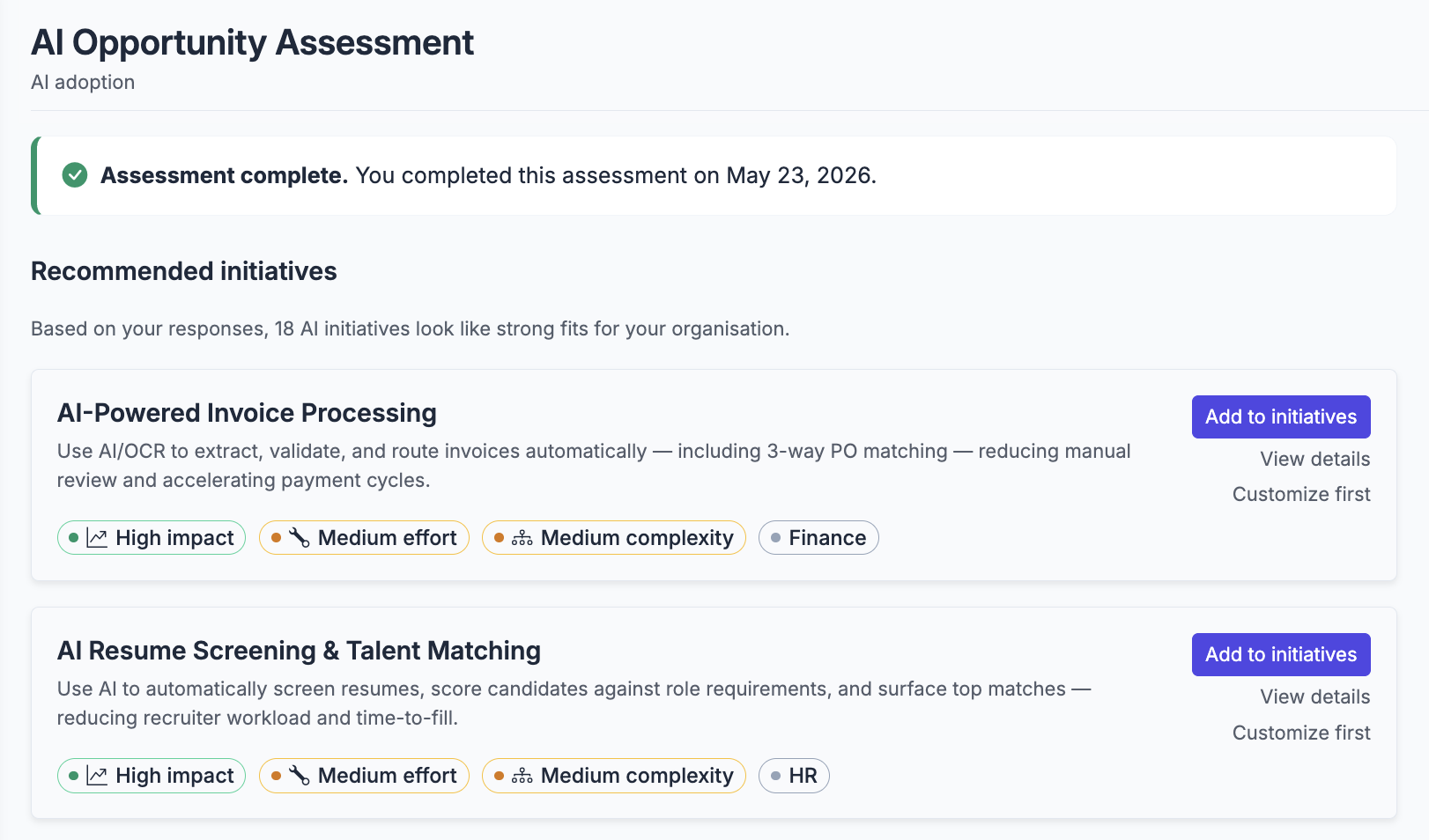
Assess your business

Answer questions about your workflows and goals. Get a tailored AI ROI exposure report by function.
2
Put every initiative on the record

Owner, stage, costs, and expected return for every AI project, in one place across your organization.

3
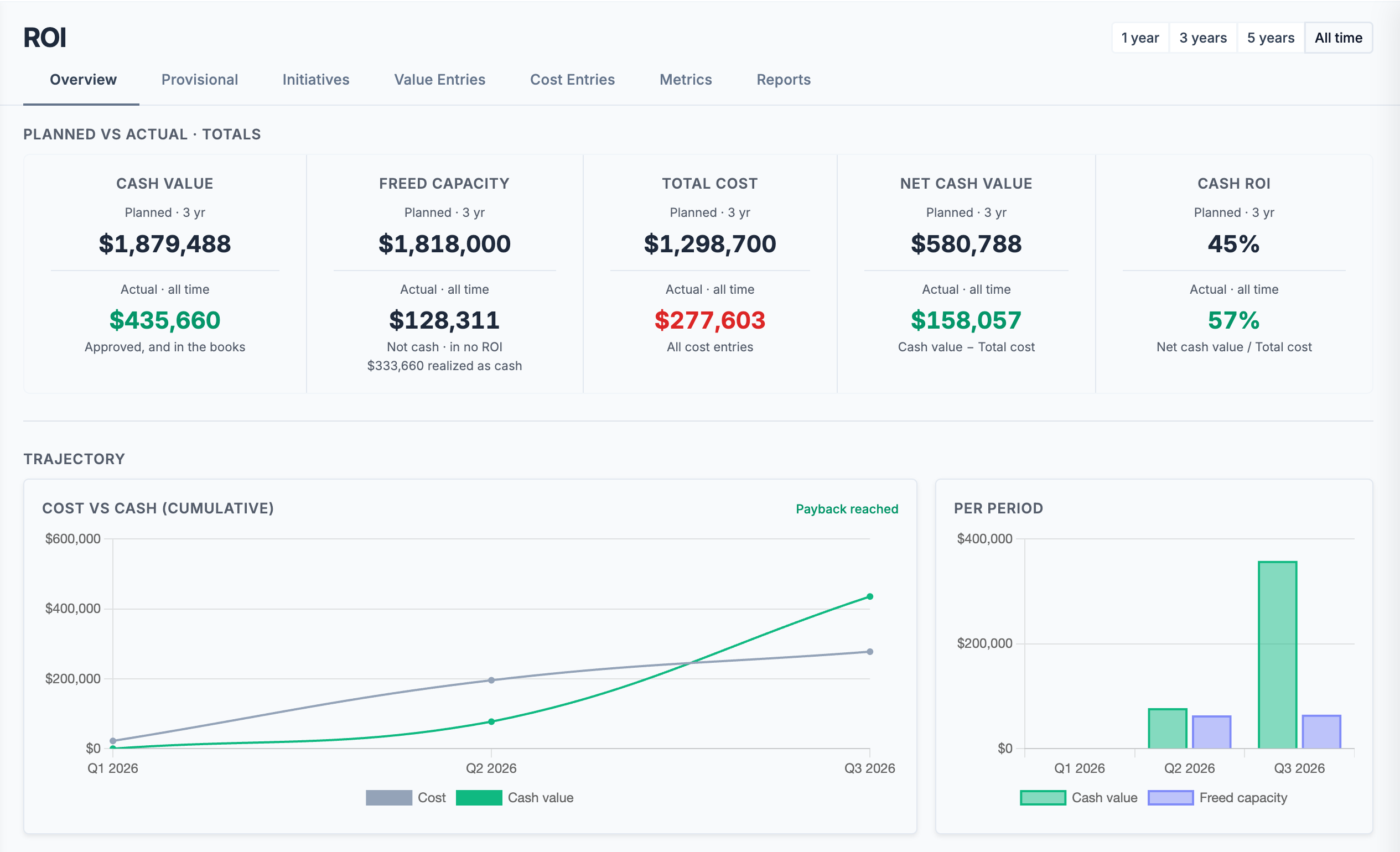
Report ROI finance signs off on

Connect your existing tools. Value lands in dollars and counts only once it's approved, not as activity metrics or vanity numbers.
A record, not a report

Spreadsheets and dashboards show you a number. Roiva keeps the record behind it: the costs, the formula, the source data, and the approval.

Spreadsheets
What many teams use today
  • Manual entry; nobody updates it after month two
  • No connection to CRM, support, or cloud spend
  • Formulas break when the methodology changes
  • One person owns it; nobody else trusts it
Generic AI dashboards
Activity, not value
  • Tokens consumed, prompts run, calls made
  • No link from spend to business outcome
  • Treats AI as a cost line, not a portfolio
  • CFO can't tell if AI paid back the investment
Roiva
Your AI portfolio, run on numbers your CFO will accept
  • Every dollar traces to a formula, a source record, or a named person
  • 30+ integrations sync cost and value automatically
  • Approval workflow keeps unapproved value out of every reported figure
  • Approved budgets tracked against actual spend, with increases above your approval threshold signed off before they apply
  • Portfolio reviews record what to scale, fix, or cut, with the numbers behind each call
  • Every AI tool, agent, and pilot on one auditable record, from business case to retirement, across sales, ops, support, and finance

What AI ROI looks like in practice

Illustrative figures, not customer results. Each is cash a bill, a contract or your CRM can show; the hours it freed are reported beside it, not added in.

Customer Support
Example
$60k/year
Five outsourced support seats not renewed once an AI agent took the tickets, shown by the contract. The agent time it freed is reported beside it as capacity.
Customer support use case
Sales
Example
$80k/year
Margin on the lift in win rate since rollout, from your CRM at your contribution margin and the share you credit to the AI. Rep hours saved on proposals sit beside it.
Sales use case
Finance
Example
$75k/year
Cash collected sooner as days sales outstanding fell, at your cost of capital, by a versioned formula that keeps its inputs. Minutes saved per invoice sit beside it.
Finance use case
Operations
Example
$95k/year
Shipping and expedite spend that fell per shipment, read from carrier bills against the rate before. Hours of scheduling saved are freed capacity, beside it.
Operations use case

What finance and ops leaders ask first

How is this different from a spreadsheet, a FinOps tool, or a BI dashboard?
A spreadsheet does the same arithmetic without the version history, and rarely survives the person who built it. FinOps tools show what you spent on AI, not what it returned. A dashboard shows a metric moving, but takes no position on what caused it or what it was worth. Roiva joins AI cost to the outcomes in your CRM, help desk, and ledger, with every dollar traced to its formula, its source record, or the person who entered it, and an audit trail.
We don't have baselines yet. Is it too early?
Almost nobody has them, which is why capturing one is often part of the first month rather than a prerequisite. Roiva records how each baseline was arrived at, so an estimate stays visibly an estimate instead of disappearing into a total. And the cheapest time to capture "before" is before your next rollout, not after it.
How long until we have a number we can defend?
If the initiative has been running in a system you connect to Roiva, your first number comes from its history, not from waiting. Connect the system, agree the formula and what "before" looked like, and Roiva works out each full month since go-live as the data syncs, ready for finance to approve. If you'd rather we do the setup, the 30-Day ROI Readout presents a board-ready number on day thirty. A rollout that's only just started needs a few weeks of readings after go-live before there's an "after" to compare.
Who owns this -- finance, or the teams running AI?
Both, with different jobs. Finance owns the methodology and signs off the reported number; the support, sales, and finance operations teams running the initiatives feed it. What makes it work is one named owner on your side, at roughly two hours a week in the first month.
Will the numbers hold up with our CFO or board?
Every value entry says where it came from. A calculated entry keeps its versioned formula and a snapshot of its inputs, so last quarter's number can be re-run on last quarter's assumptions. A synced entry keeps the source records it was counted from, and an entry a person entered names the person and the documents they cite. An approval step keeps unapproved value out of reported ROI, and ROI is taken over cash alone: hours your team got back are reported beside it as freed capacity, and count as cash only when a document shows they became cash. Attribution is an explicit rule your team chooses and documents -- not a causal experiment, and we don't claim otherwise. Read the measurement methodology →
How is Roiva priced?
Start free: the free account measures up to 3 initiatives at a time, lists any number of ideas, and never expires. When you measure more, one annual subscription priced by how many initiatives you measure at a time, from $15K a year — not by headcount, seats or usage. To have us set up the first number, a 30-Day ROI Readout takes one initiative to a board-ready readout for $7,500, credited in full against year one. See pricing and the 30-Day ROI Readout →
How do you handle our data and security review?
Your data is never used to train models, and the Roiva Assistant, built on Anthropic's Claude, receives only the context a response needs. Our SOC 2 Type 2 program with Oneleet started on September 25, 2026, and an independent CPA firm will issue the report. Request our policies, and the report once it's issued, through the Roiva Trust Center. Until then, we'll send Oneleet's engagement letter and our sub-processor list, sign our DPA, and answer your security questionnaire within one business day. Read the security overview →

Run your first AI initiatives in Roiva, free.

Measure up to 3 initiatives at a time on your own data, list every idea you're weighing, and keep it all when you measure more. No card, no expiry.