Productivity
Google Workspace
Roiva prices the meeting time an AI assistant gives back, from Google Workspace calendars: attendee-hours before and after, at your rate, keeping no names.
What it answers
How much meeting time an AI meeting assistant or async tools give back to the team
What Roiva reads
Events on the calendars you choose: when, how long and how many were invited. Google sends each event's title, description and attendees; Roiva keeps none of them.
Setup
One OAuth approval in Google, and a Workspace admin's approval if your admin blocks new apps
What you can measure with Google Workspace
Meeting time, priced
Attendee-hours in meetings before the assistant, less attendee-hours now, at your blended hourly rate, as freed capacity.
google_workspace.calendar.meeting_hours
google_workspace.calendar.avg_attendees
Starts from the AI Meeting Assistant template
Fewer, shorter, smaller
Meeting count and average length by month against their baseline, to see which of the three the assistant changed.
google_workspace.calendar.meeting_count
google_workspace.calendar.avg_meeting_duration_mins
A baseline from your own calendars
The baselines come from your calendars' own months before the assistant, not an industry average, and each meeting counts once however many calendars hold it.
Freed time, not cash
Meeting time given back is capacity, reported beside cash ROI. It counts as cash only once it shows up in what you pay.
A worked month
An AI meeting assistant for a 60-person operations team
Meeting Freed Capacity, from the AI Meeting Assistant template, for September
| Meeting hours a month before the assistant | 1,240 | Calendar history |
| People invited to the average meeting before | 4.6 | Calendar history |
| Meeting hours in September | 1,180 | Google Workspace |
| People invited to the average meeting in September | 4.1 | Google Workspace |
| Blended hourly rate | $62 | Set by Finance |
(1,240 × 4.6 − 1,180 × 4.1) × $62
$53,692 freed capacity for September, reported beside cash ROI, never in it
Most of it came from smaller meetings, not fewer: the hours barely moved while the invite lists shrank. Attendee counts are the people invited, which is what a calendar records, on both sides.
Illustrative figures. Roiva keeps every input with the entry it calculates, and none of it counts until it's approved.
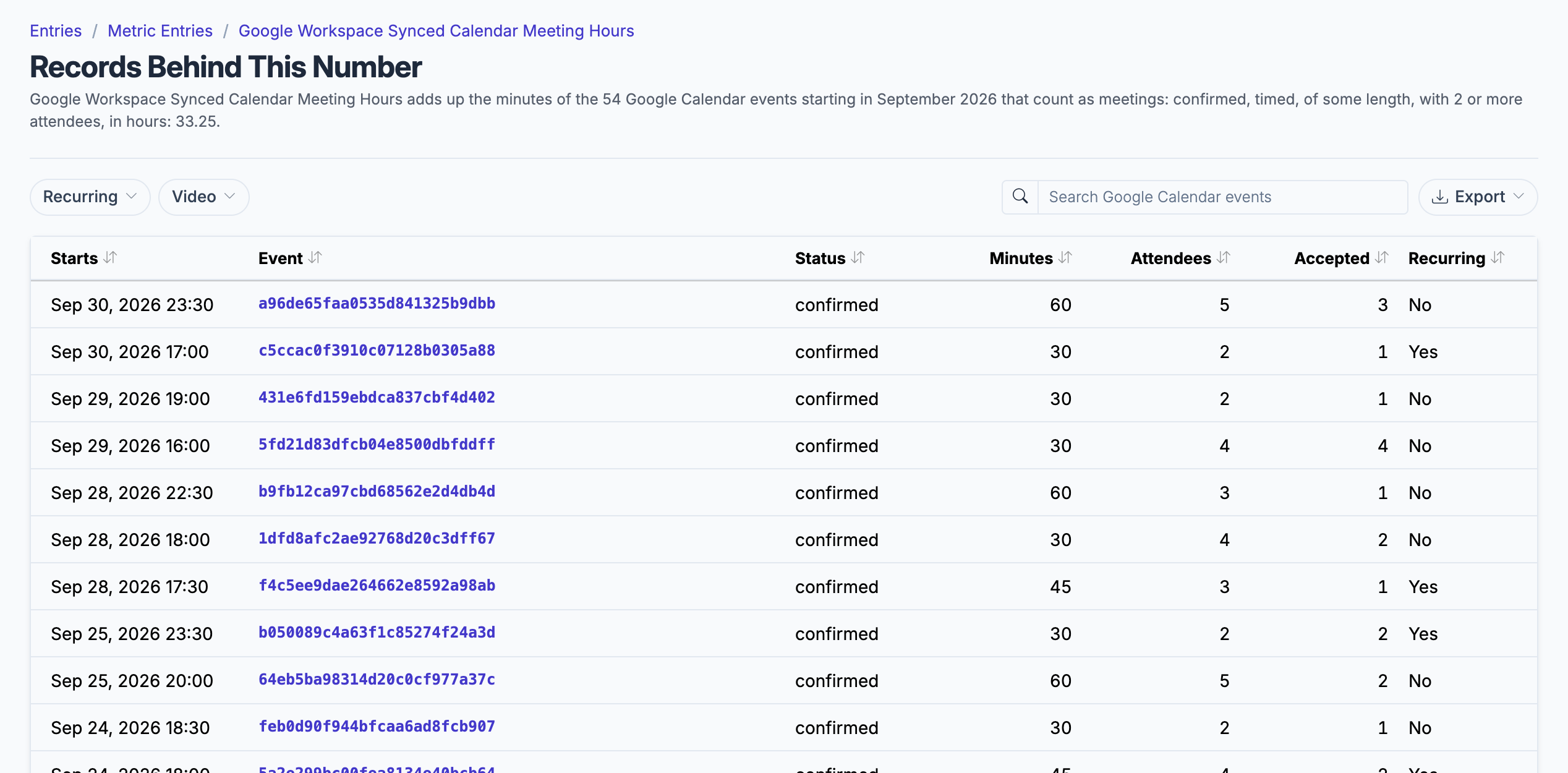
The meetings behind a month's hours, by day and length, with no title or attendee kept.
What gets synced
Roiva writes these metric observations on each sync. Reference the key in a value formula to use this data in your ROI calculations.
Calendar Events
google_workspace.calendar.meeting_count
Meetings on the Connected Calendar
count
google_workspace.calendar.meeting_hours
Meeting Hours on the Connected Calendar
duration
google_workspace.calendar.avg_meeting_duration_mins
Avg Meeting Duration on the Connected Calendar (minutes)
duration
google_workspace.calendar.avg_attendees
Avg Attendees per Meeting on the Connected Calendar
count
What Roiva keeps
Reads: Events on the calendars you choose, from 12 months back to the end of this month, including all-day, out-of-office and focus time. Google sends each event's title, description and attendees; Roiva keeps none of them.
Keeps: Records of calendar events, plus the totals worked out from them.
How to connect
You connect Google Workspace from inside Roiva, so you need a Roiva workspace first. Sign in to connect it now. New to Roiva? Start free with your work email, take the free assessment and create your workspace at the end, or request an invite.
- In Roiva: Connect via OAuth — you will be redirected to Google to authorize
- In Google Admin console (only if Google says your administrator blocks Roiva, admin_policy_enforced): A Workspace admin allows Roiva under Security → Access and data control → API controls → Manage App Access — search for Roiva and set it to Trusted, or to Specific Google data with Calendar
- In Google: Grant read-only access to Google Calendar. Roiva also sees your email address and name, never your Gmail. Leave the calendar permission ticked on Google's consent screen: without it the connection signs in but can't read a calendar
- Back in Roiva: The connection page checks each step and says what's missing. Once it's all ticked, click Test Connection
- Back in Roiva: After connecting, link this connection to an initiative on the Initiatives tab
Need help?
Email hello@roiva.ai with what you're seeing, and you'll hear back within one business day.
Google Workspace
Start free, then connect Google Workspace once your workspace is set up. Or begin with the free AI ROI exposure assessment.
Start free → Sign in to connectRelated integrations