
Attribute won deals to your AI initiatives, by a rule you can audit.
Roiva ties won deals to your AI by a CRM field or deal-name pattern your RevOps lead sets, and books what they bring in at your margin, not the top line.
The problem
Reps love new AI tools. Your CFO wants deal-level evidence — which deals your team marked as AI-assisted, what margin they brought in, and what the CAC offset actually looks like.
Worked example
One quarter of AI lead scoring, line by line
Illustrative figures, not a customer's: a B2B sales team on Salesforce scoring every inbound lead with AI.
-
1
Measure the change against your own baseline
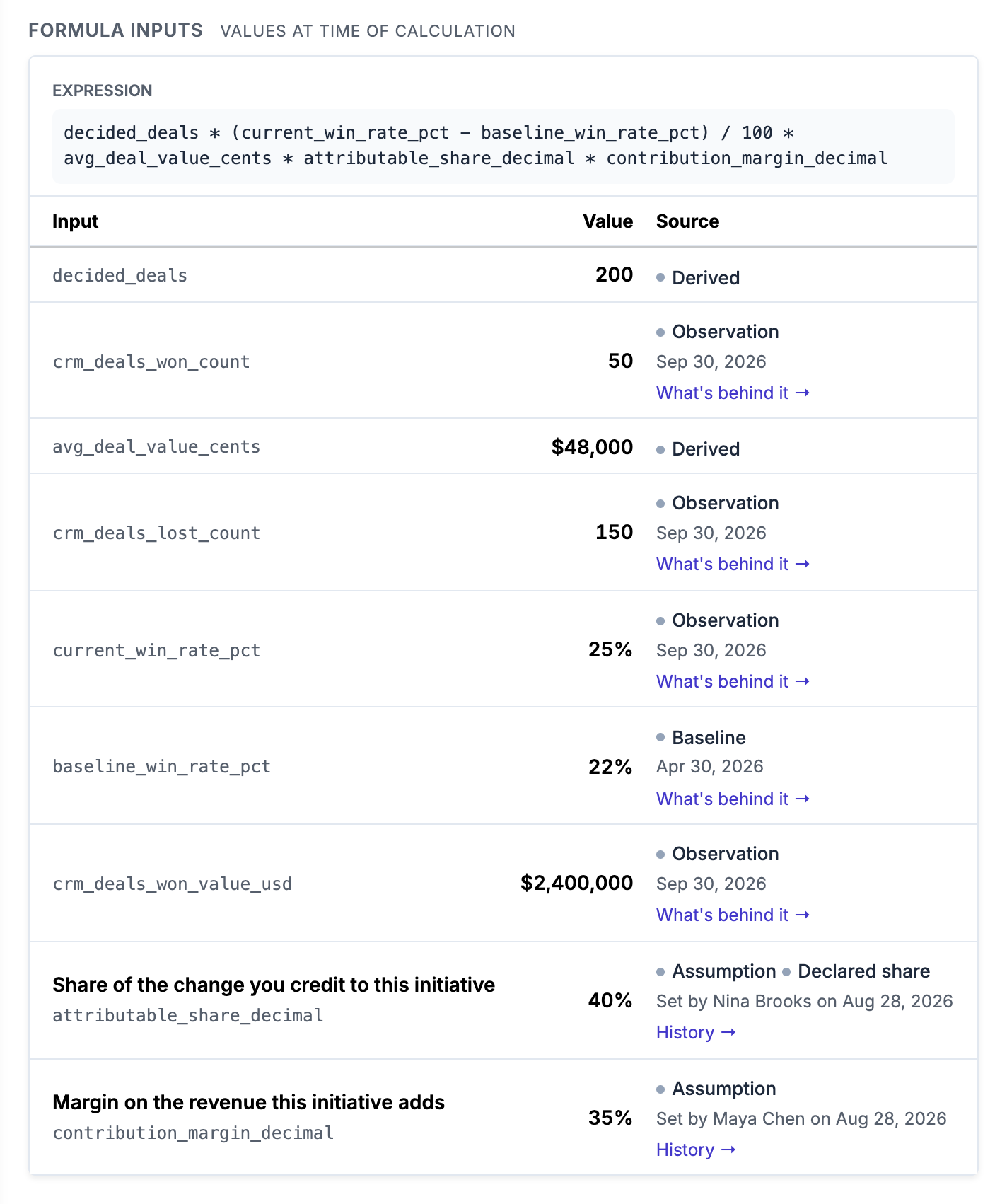
The win rate is deals won ÷ deals decided, won plus lost, from your CRM. The baseline is the same figure for the three months before rollout. Open pipeline isn't the base: an open deal would be counted again every month until it closed.
Deals decided this quarter 200 Win rate, the three months before rollout 22% Win rate this quarter 25% Deals won that the old win rate would have lost 6 -
2
Credit only the AI's share, at your margin
Pricing, competitors and deal mix move a win rate too, so your RevOps lead sets the share the AI gets credit for. Roiva ships no default, records who set it and when, and holds every entry that reads it for a person's approval. Revenue isn't return either: it's booked at the contribution margin finance sets.
Revenue from those 6 deals, at $48,000 each $288,000 Share credited to AI scoring 40% Contribution margin 35% Cash value $40,320 -
3
Value a faster close as money arriving sooner
A deal that closes 8 days sooner is the same deal, not a new one. What it's worth is your cost of capital on its margin for those days, at the same share.
Deals won this quarter 50 Days the sales cycle shortened, 74 to 66 8 Cost of capital, a year 9% Cash value $663 -
4
Count rep hours as capacity, not cash
Reps spend less time qualifying leads the AI already scored. They're paid the same, so the hours are freed capacity beside the ROI, until a hire you didn't make shows they became cash.
Leads scored 3,600 Minutes qualifying a lead, before and after 6 → 2 Rep cost per hour $60 Freed capacity $14,400 -
5
Set it against everything the AI costs
CRM seats aren't counted: you pay for them either way. The tool's invoice reaches the initiative from your books through a vendor mapping.
Lead scoring tool, for the quarter $15,000 Model usage for scoring, from OpenAI's Admin API $2,400 RevOps time building the scoring field: 60 hours × $75 $4,500 Total cost $21,900
Booked as top-line revenue with all the credit going to the AI, the same quarter reads 1,215%. The difference is the share and the margin, each set by a named person and on the record.
None of it counts until a person approves it. Each figure keeps its versioned formula and a snapshot of its inputs, and the share and margin keep who set them and when. How Roiva calculates value →
What a reviewer sees in Roiva
Steps 1 and 2 as Roiva calculates them: the formula, every figure it read with its source, the baseline from before rollout, and the share and margin with who set them and when. Because it reads a share, it waits in Approvals for a person.
Example initiatives
What teams are tracking with Roiva
A few of the initiative templates ready to deploy from the in-app library. Each ships with its formulas and the integrations it reads, and takes its baseline from your own history where your systems hold it.
AI lead scoring
Compare lead-to-opportunity conversion against the baseline you declared before rollout. Attribute closed-won deals by deal-name pattern or custom CRM field.
AI proposal generation
Measure cycle-time reduction. Rep hours saved are freed capacity, reported beside the margin on won deals and never added to it.
Conversation intelligence
Compare win rate and sales-cycle length against their pre-rollout baselines, then map specific coached deals to closed-won.
Connects to
Works with the systems you already run
The integrations most relevant to Sales initiatives, and what Roiva does with each one.

Roiva shows whether Agentforce and your AI sales tools are paying back, booking Salesforce deals and AI-handled conversations at your margin.

Roiva shows whether your AI sales and marketing tools are paying back, pricing the change in HubSpot win rate, sales cycle and lead conversion in dollars.

Roiva books the Pipedrive deals your AI tools helped win, by a custom field you set, at your margin, and prices the change in win rate and sales cycle.

Roiva books OpenAI spend to the initiative that ran it, project by project, so each AI initiative's ROI is net of what its models actually cost.

Roiva books Anthropic's Claude spend to the initiative that ran it, workspace by workspace, and prices Claude Code's accepted edits as developer time freed.
Common questions
AI ROI for Sales — FAQ
How does Roiva attribute closed-won deals to AI initiatives?
Does Roiva handle recurring revenue correctly?
Which CRMs does Roiva integrate with for sales ROI tracking?
Can I attribute deal velocity improvements to specific AI tools?
How do I handle the cost side of an AI sales initiative?
Measure your first AI initiatives in Roiva, free.
Measure up to 5 initiatives at a time on your own data, list every idea you're weighing, and keep it all when you measure more. No card, no expiry.