
Price what your AI coding assistants actually give back.
Roiva counts the suggestions and edits your developers accept, prices them at a figure you set, and sets them beside Copilot's seats and Claude Code's spend.
The problem
Seat counts and acceptance rates show your engineers use AI. They don't say what that's worth, and an hours-saved estimate isn't money your CFO can bank.
Worked example
One quarter of Copilot and Claude Code, line by line
Illustrative figures, not a customer's: 120 engineers on GitHub Copilot, 40 of them also using Claude Code.
-
1
Count what developers accepted
Copilot's acceptances come from GitHub's Copilot report, Claude Code's accepted edits from its analytics. They're different units: one Copilot acceptance can bundle several completions, so each is counted and priced on its own.
Copilot acceptances, from GitHub 54,000 Claude Code edits accepted, from Anthropic 18,000 Engineers using either 120 -
2
Price each at a figure you set
Nothing published measures the minutes one acceptance saves, so Roiva's convention is 1 minute, marked low confidence. Your engineering lead set their own figures with the reasoning on record, and each entry says whose figure it used.
Minutes per Copilot acceptance (Roiva's convention: 1) 1.5 Minutes per Claude Code edit 3 Developer cost per hour $95 Freed capacity $213,750 -
3
Check it against Jira
Throughput is the same engineers' time measured another way, so it sits beside the acceptances rather than being added to them. If acceptances climb and throughput doesn't, that's the conversation the next review should have.
Issues resolved, the quarter before and this quarter 2,600 → 2,900 Average cycle time, days 6.1 → 5.2 Added to value No -
4
Count as cash only what a document shows
Your engineers are paid the same, so the hours aren't cash. Contract developers you stopped paying for are, recorded for each month with the contract cited, and never more than the capacity approved for that month.
Freed capacity, step 2 $213,750 2 contract developers not renewed, contract cited $96,000 Capacity not yet cash $117,750 -
5
Set it against everything the AI costs
GitHub's plan seats and the rest of its invoice aren't counted: only Copilot is the initiative's cost.
Copilot Business, 120 seats, from GitHub's bill $6,840 Claude spend for Claude Code, from Anthropic's cost report $21,000 Enablement and rollout time: 80 hours × $95 $7,600 Total cost $35,440
Priced as savings, the same quarter reads 503%. The difference is engineering time no budget has shown yet.
None of it counts until a person approves it, and each figure says whether it rests on your minutes or on Roiva's convention. How Roiva calculates value →
What a reviewer sees in Roiva
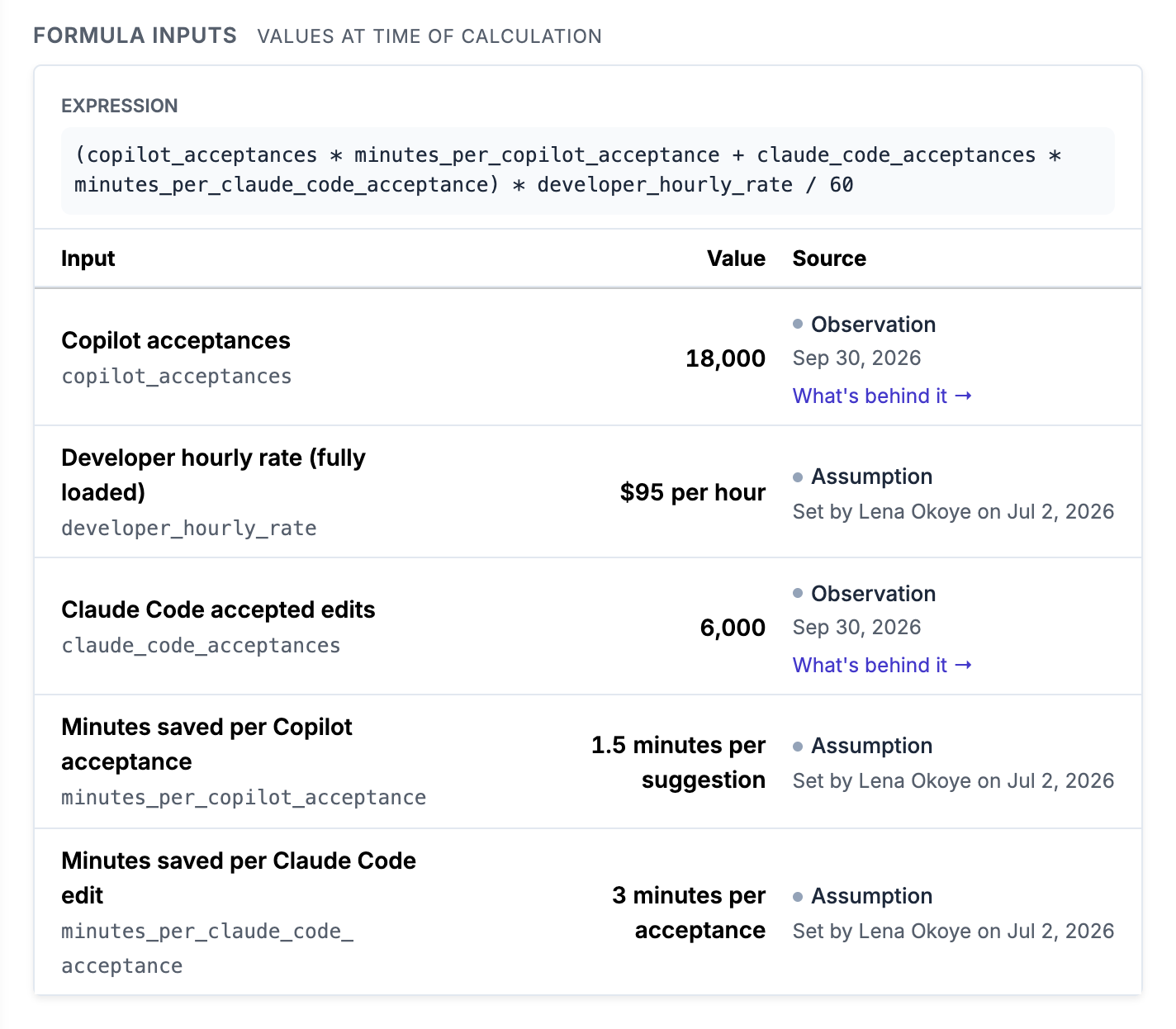
September, one month of the quarter above, as Roiva calculates it: the formula, Copilot's acceptances and Claude Code's edits with what's behind them, and each minutes figure and the rate with who set them and when.
Example initiatives
What teams are tracking with Roiva
The AI Coding Assistant Rollout template ships with a formula for each way an assistant reports its work. Use the one your tools support.
Copilot and Claude Code together
Copilot acceptances × minutes saved per Copilot acceptance, plus Claude Code's accepted edits × minutes saved per edit, at your developer rate. Each is priced in its own unit, because a Copilot acceptance can bundle several completions.
Claude Code on Claude Enterprise
The same, with Claude Code's accepted edits read across your Claude Enterprise organization, where the seats are, rather than from API workspaces.
OpenAI Codex, by lines kept
Where an assistant reports no acceptance count, the lines of code it wrote that developers kept × minutes saved per line. The weaker measure, and the formula says so.
Issue throughput from Jira
Issues resolved, cycle time and story points against the months before rollout. Keep it as a cross-check beside the assistant's figures rather than pricing it too, or the same developer time is counted twice.
Connects to
Works with the systems you already run
The integrations most relevant to Engineering initiatives, and what Roiva does with each one.
Roiva prices the time GitHub Copilot gives your developers back and books Copilot's seats from GitHub's bill, so an AI coding rollout shows both sides.

Claude Code's accepted edits, from Anthropic's Admin API or across your Claude Enterprise organization, and Anthropic's Claude spend by workspace.
Roiva prices the developer time OpenAI Codex saves from the lines of code it wrote that your developers kept, read from ChatGPT Enterprise.
Roiva tracks the Jira throughput behind an AI coding rollout, issues resolved, cycle time and story points, against the months before it, beside what it costs.
Common questions
AI ROI for Engineering — FAQ
How do I measure ROI from GitHub Copilot or Claude Code?
Where does the minutes-saved-per-acceptance figure come from?
We use both Copilot and Claude Code. Will Roiva count the same work twice?
Why not just count lines of code?
Does Roiva prove the assistant made us faster?
Measure your first AI initiatives in Roiva, free.
Measure up to 3 initiatives at a time on your own data, list every idea you're weighing, and keep it all when you measure more. No card, no expiry.