
Run your AI agents and initiatives like a portfolio, not a pile.
Every AI initiative on one list, with an owner, a budget, its cost and cash value from your systems, and a decision on record to scale, fix or cut it.
The problem
AI work is scattered across teams and tools. Nobody can answer 'how many AI projects do we have, and which are working?'
Worked example
One quarter's portfolio review, line by line
Illustrative figures, not a customer's: five AI initiatives across support, finance, sales, engineering and legal, reviewed at quarter end. The first three are this site's other worked examples.
-
1
Put every AI initiative on one list
Each has an owner, a stage and an approved budget. AI spend your providers billed that no initiative books, such as API keys nobody linked, is reported as unmeasured, not spread across the five to make the total add up.
Live initiatives up for review 5 Ideas still being scoped or reviewed, listed but not measured 9 AI spend no initiative books $11,400 Cost of the five this quarter $193,650 -
2
Net each one's cash against its cost
Cash only: costs that fell, losses avoided, margin on revenue won, and capacity a document showed became cash. Three initiatives pay for the portfolio; two cost money and return none yet.
Support triage and deflection: $87,000 cash, $69,000 cost +$18,000 AP bill automation: $82,560 cash, $30,750 cost +$51,810 AI lead scoring: $40,983 cash, $21,900 cost +$19,083 Engineering copilot, 300 seats: $0 cash, $54,000 cost −$54,000 Contract review pilot, 4 active users: $0 cash, $18,000 cost −$18,000 Portfolio net cash +$16,893 -
3
Keep freed capacity beside it
Hours given back are real, but no budget has shown them yet. They sit beside the ROI, initiative by initiative, so the review can ask which hire not made or contract not renewed will turn them into cash.
Support triage and deflection $214,035 AP bill automation $41,340 AI lead scoring $14,400 Engineering copilot, 300 seats $96,000 Contract review pilot, 4 active users $4,500 Capacity not yet cash $370,275 -
4
Decide, and record why
Each decision keeps its reason and the figures it was made against, and sets when the initiative comes back up, so next quarter reads the call as it was made. The copilot's fix: name the hires it replaces, or cut seats to the people using it.
Support triage and deflection Scale AP bill automation Continue AI lead scoring Continue Engineering copilot, 300 seats Fix Contract review pilot, 4 active users Retire Cash ROI of the 3 that pay 73%
Priced as savings, the same quarter reads 200%. The copilot alone adds $96,000 of hours to that figure and nothing to the cash.
Portfolio Review lists every live initiative with its cost to date, cash value, cash ROI and last decision, the ones due first. Portfolio reviews and decisions →
Where the review starts in Roiva
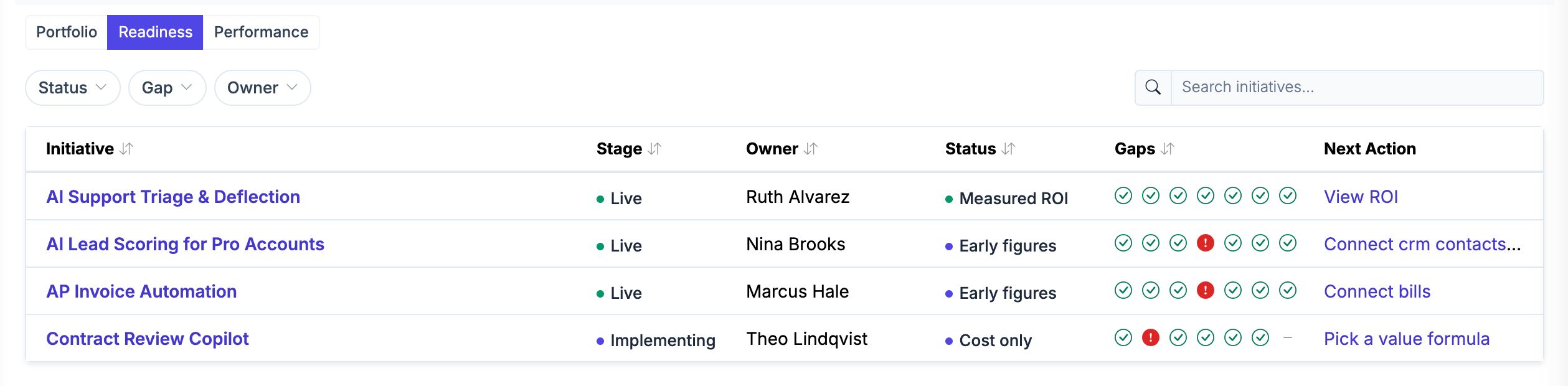
Step 1 as Roiva shows it: every initiative on one list, with how far each is from a figure you can report, what's missing, and the next thing it needs. An initiative with only costs says so instead of showing a return.
Example initiatives
What teams are tracking with Roiva
A few of the initiative templates ready to deploy from the in-app library. Each ships with its formulas and the integrations it reads, and takes its baseline from your own history where your systems hold it.
AI coding assistants
Copilot acceptances and Claude Code's accepted edits × the minutes each saves × your developer rate, each priced in its own unit, as freed capacity. Seats and usage come from GitHub's and Anthropic's own billing.
Workflow automation
Successful runs from n8n, Make or Zapier × the minutes of manual work one run replaces × your ops rate, as freed capacity. Failed runs don't count.
AI meeting assistant
Attendee-hours in meetings before and after, from your own calendar history, at your blended rate, as freed capacity. Attendees are the people invited, on both sides of the comparison.
Connects to
Works with the systems you already run
The integrations most relevant to AI Operations initiatives, and what Roiva does with each one.

Copilot's acceptances and seats from GitHub, and Claude Code's accepted edits from Anthropic or Claude Enterprise with Anthropic's spend: both sides of a coding-assistant rollout.


Meeting count, hours and attendees from your calendars, as the before and after for a meeting assistant, keeping no names.
Roiva tracks the Jira throughput behind an AI coding rollout, issues resolved, cycle time and story points, against the months before it, beside what it costs.

Roiva posts initiative stage changes, value entry approvals, notes and budget alerts to the Slack channel you choose. It can't read your messages.
Common questions
AI ROI for AI Operations — FAQ
How do I track an AI initiative portfolio across multiple teams?
What stages does an AI initiative go through in Roiva?
Can I track AI ROI across multiple teams in one place?
How do we decide which AI initiatives to scale or cut?
How does Roiva handle the cost side of AI initiatives at portfolio level?
How many initiatives can we run on the free account?
Measure your first AI initiatives in Roiva, free.
Measure up to 5 initiatives at a time on your own data, list every idea you're weighing, and keep it all when you measure more. No card, no expiry.