
Finance
NetSuite
Roiva prices AP automation from the vendor bills already in NetSuite, and books each AI vendor bill to the initiative it pays for, journals included.
What it answers
Whether AP automation and your other AI initiatives pay back, from the bills and income statement already in NetSuite
What Roiva reads
Invoices, vendor bills and card charges, eight columns each, monthly revenue and expense totals, and your chart of accounts and segments. Never a line, memo, address or contact.
Setup
Token-based authentication for an integration user, with a role you make from the setup steps
What you can measure with NetSuite
AP automation, priced
Vendor bills received each month × the minutes per bill your time study saved × your AP labor rate, as freed capacity.
netsuite.vendor_bills.count
Starts from the AI-Powered Invoice Processing template
AI vendor bills, booked
Assign a vendor to an initiative, by exact name or a word in it, at the share you set, and an allocation rule books its bills and card charges there as they sync.
netsuite.vendor_bills.volume
Journals back to NetSuite
When you lock a month, Roiva posts the reclass journal to NetSuite by department, class or location, from the accounts each bill hit, pro rata.
The income statement beside it
Revenue, expenses and net income by month, tracked beside your initiatives, never priced as their value.
netsuite.financials.revenue
netsuite.financials.expenses
netsuite.financials.net_income
A worked month
AI invoice capture for a five-person AP team
Invoice Processing Freed Capacity, from the AI-Powered Invoice Processing template, for September
| Vendor bills received in September | 4,200 | NetSuite |
| Minutes per bill before go-live | 9 | Your time study |
| Minutes per bill in September | 3.5 | Your time study |
| AP labor rate, an hour | $38.40 | Set by Finance |
4,200 bills × (9 − 3.5) minutes × $38.40 ÷ 60
$14,784 freed capacity for September, reported beside cash ROI, never in it
It counts as cash only once it shows up in what you pay, such as temp clerks not renewed, recorded with the document that shows it.
Illustrative figures. Roiva keeps every input with the entry it calculates, and none of it counts until it's approved.
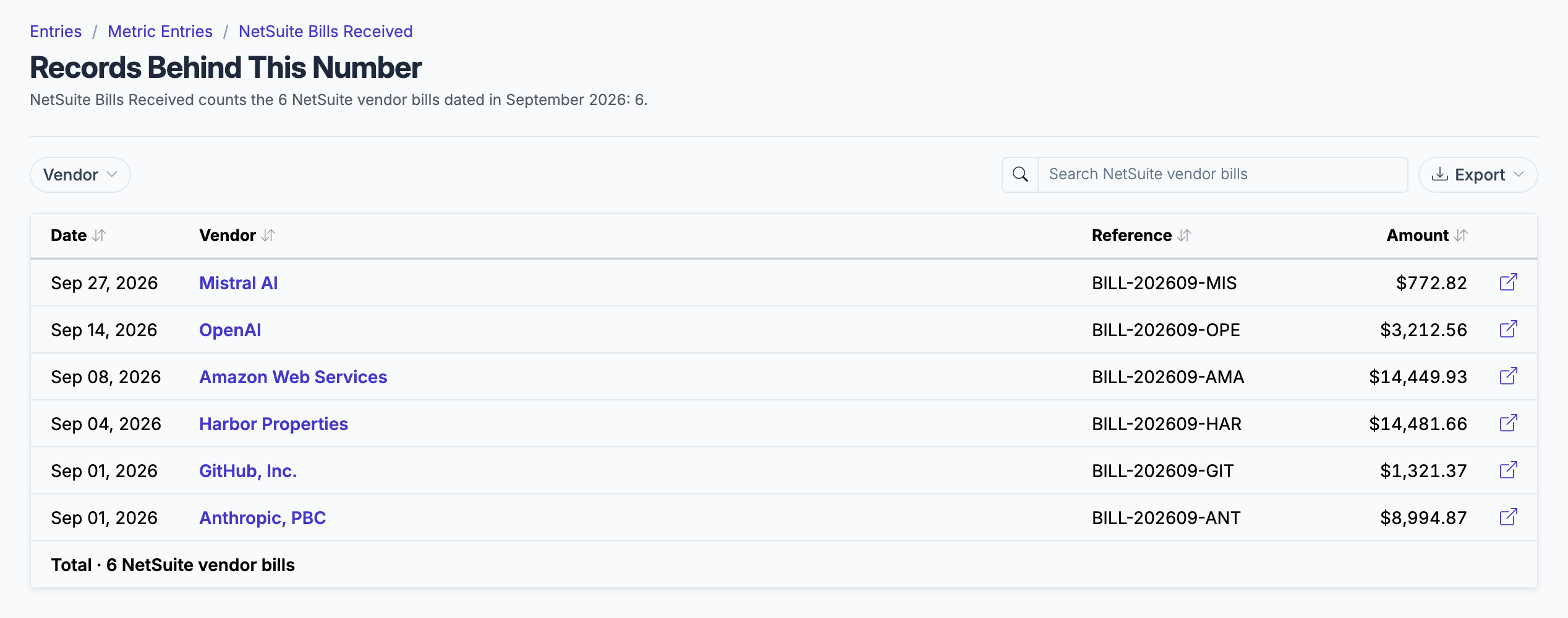
The vendor bills behind a month's count, each a click from the bill in NetSuite.
What gets synced
Roiva writes these metric observations on each sync. Reference the key in a value formula to use this data in your ROI calculations.
Financials (Income Statement)
netsuite.financials.revenue
Revenue
currency
netsuite.financials.expenses
Expenses
currency
netsuite.financials.net_income
Net Income
currency
Invoices (AR)
netsuite.invoices.count
Invoice Count
count
netsuite.invoices.volume
Invoice Volume
currency
netsuite.invoices.paid_count
Paid Invoice Count
count
Vendor Bills (AP)
netsuite.vendor_bills.count
Vendor Bill Count
count
netsuite.vendor_bills.volume
Vendor Bill Volume
currency
What Roiva keeps
Reads: Invoices, vendor bills and credit card charges that aren't voided, dated in the last 12 months, eight columns each; the base currency the books are kept in; monthly revenue and expense totals for the same 12 months; and the chart of accounts, departments, classes and locations. Never a line, memo, address or contact.
Keeps: Records of invoices, vendor bills, credit card charges and income statement totals, plus the totals worked out from them.
How to connect
You connect NetSuite from inside Roiva, so you need a Roiva workspace first. Sign in to connect it now. New to Roiva? Start free with your work email, take the free assessment and create your workspace at the end, or request an invite.
- In NetSuite: Go to Setup → Company → Enable Features → SuiteCloud and check Token-based Authentication and REST Web Services; on the Analytics subtab check SuiteAnalytics Workbook, then save
- In NetSuite: Go to Setup → Users/Roles → User Management → Manage Roles → New and create a role (not Administrator) with Setup → Log in using Access Tokens (Full), REST Web Services (Full) and Accounting Book (View), which the income statement reads; Reports → SuiteAnalytics Workbook (Edit); Transactions → Find Transaction, Invoice, Bills and Credit Card (View), the last for card charges; Lists → Perform Search, Customers and Vendors (View), which name each invoice's customer and each bill's vendor; and Lists → Accounts, Currency, Departments, Classes and Locations (View). For Roiva to post a journal when you lock a period, add Transactions → Make Journal Entry (Edit)
- In NetSuite: Go to Lists → Employees → Employees, edit the integration user, and add that role on the Access subtab
- In NetSuite: Go to Setup → Integration → Manage Integrations → New, name it Roiva, check Token-based Authentication, leave the other boxes as they are, and save; copy the Consumer Key and Consumer Secret, which NetSuite shows only once
- In NetSuite: Go to Setup → Users/Roles → Access Tokens → New, pick the Roiva integration record, the integration user and the role you created, save, and copy the Token ID and Token Secret, which NetSuite shows only once
- In NetSuite: Go to Setup → Company → Company Information and copy the Account ID exactly as shown — a sandbox's looks like 1234567_SB1, not the 1234567-sb1 in its URL
- Back in Roiva: Enter all five values — Account ID, Consumer Key, Consumer Secret, Token ID, Token Secret — in the form fields above and save
- Back in Roiva: The connection page checks the sign-in and the role, and says which is missing. Once it's all ticked, click Test Connection
- Back in Roiva: To book its bills, open Finance › AI Spend and show the unbooked vendors. It lists the vendors on the synced bills and expenses that no initiative books, AI vendors first. Assign each to the initiatives it serves, which writes its allocation rule, or set it aside
- Back in Roiva: To count its invoices or income statement toward an initiative, link the connection to it on the Initiatives tab
Need help?
Email hello@roiva.ai with what you're seeing, and you'll hear back within one business day.
NetSuite
Start free, then connect NetSuite once your workspace is set up. Or begin with the free AI ROI exposure assessment.
Start free → Sign in to connectRelated integrations